If AI terminology makes your head spin, you’re not alone. “AI,” “Generative AI,” “Agentic AI” — the buzzwords fly fast, but most marketers we talk to just want to know what this really means for their business and what they need to understand to make smart decisions. Here’s the good news: You don’t need a PhD in computer science. You need a strategy. Let’s break this down.
Let’s Define the Three Big Ones
1. Traditional AI
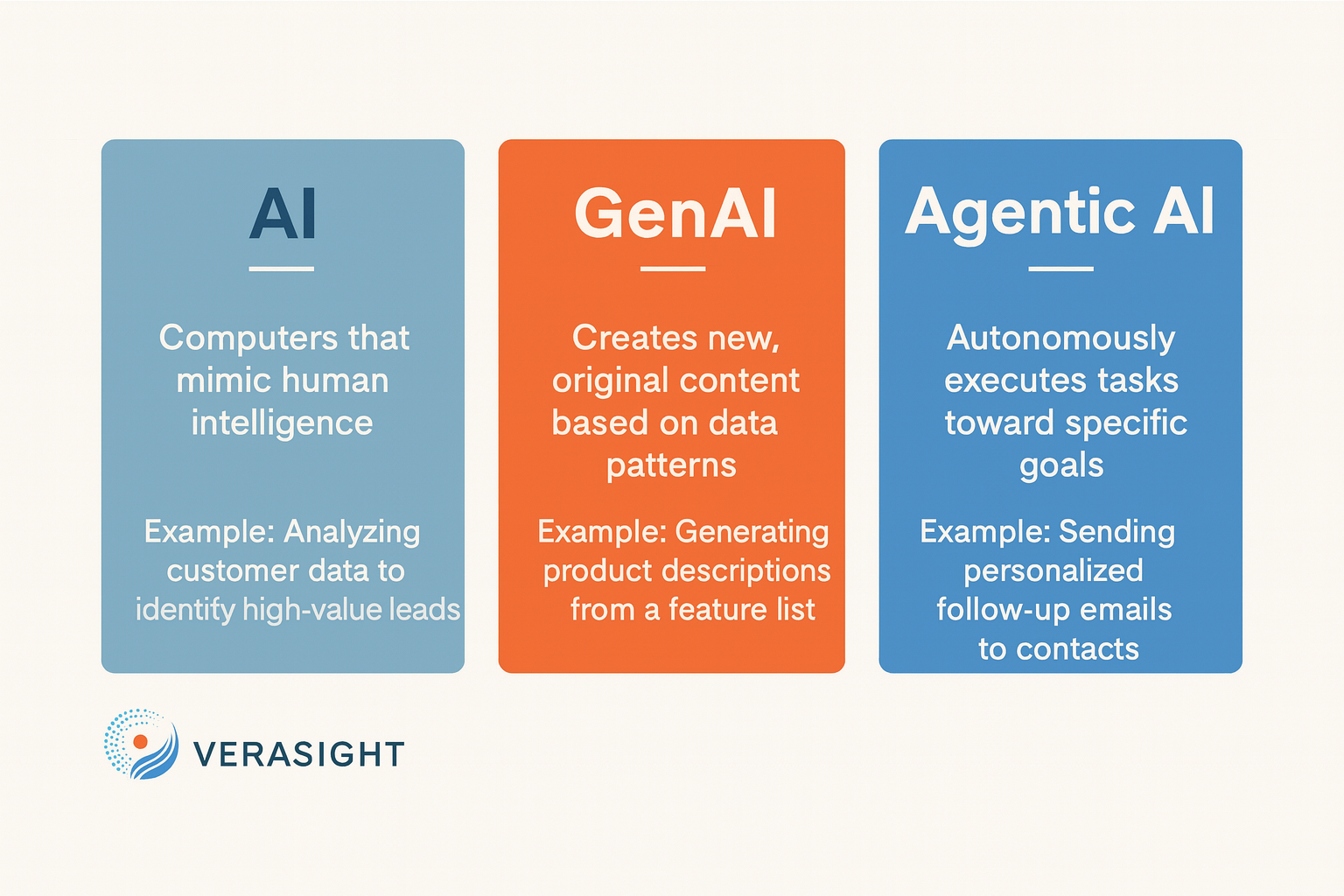
This is the classic AI — pattern recognition, prediction, and automation based on structured data. Think of your CRM suggesting next-best actions based on past deals.
Example: A logistics company uses AI to score inbound leads based on location, budget, and purchase history. Their sales team now spends time on qualified opportunities rather than chasing cold leads.
2. Generative AI (GenAI)
This is the content creator. It generates new material, like text, images, or code, based on prompts. ChatGPT is a GenAI tool.
Example: A B2B SaaS provider uses GenAI to draft email campaigns and proposal outlines. Their marketers now move faster through first drafts and focus more on strategy.
That said, GenAI is more involved than it may seem. For the best results, it needs training on your brand voice, industry language, and relevant data. It also requires iteration — testing outputs, refining prompts, and adjusting based on feedback. According to a 2023 McKinsey report, organizations that fine-tune GenAI models on their proprietary data see up to 40% better performance in accuracy and relevance compared to generic implementations.
3. Agentic AI
This type of AI doesn’t just generate, it acts. It can make decisions, take initiative, and complete tasks aligned to a goal.
Example: A professional services firm deploys agentic AI to manage inbound client inquiries. It reviews the request, pulls relevant case studies, drafts a response, and notifies a team member if human input is needed.
Like GenAI, Agentic AI requires thoughtful setup to be effective. It needs clear goals, curated data, and continuous tuning. Without that, it can create more noise than value. It’s powerful, but not plug-and-play.
Which AI Solves What Marketing Challenge?
Start with Strategy, Not Hype
Here’s how to get started:
- Clarify your business goals. Are you trying to shorten the sales cycle, improve email engagement, or generate more top-of-funnel content?
- Map pain points to the right AI type. Example: If your team spends hours qualifying leads, traditional AI could help.
- Start small and prove value. You don’t need to overhaul everything. Run a pilot, measure the impact, and scale what works.
- Train your team. Even the smartest AI won’t work without human oversight. Make sure your marketers understand how to guide and QA the tools they use.
How Verasight Helps
We work with B2B companies in manufacturing, professional services, and healthcare IT who want to use AI without the guesswork. Our approach starts with your strategy, not a tool demo.
That means:
- An audit of your current marketing workflows
- A clear recommendation on where AI can drive ROI
- Hands-on support to pilot, train, and scale
You don’t need to become an AI expert. You need a partner who gets marketing and technology.
Let’s talk about how we can help you cut through the noise and make smarter, faster decisions.